
Introduction: The Evolutionary Leap of AI Agents
With the recent debut of Gemini 3, artificial intelligence reasoning capabilities have reached new heights. However, for AI to truly be an "agent" — capable of pursuing goals and solving real-world problems on behalf of users — pure intelligence is not enough. It essentially needs to reliably interact with tools and external data. This is where the Model Context Protocol (MCP) comes into play.
Often likened to a "USB-C for AI", the Model Context Protocol developed by Anthropic has quickly become a standard for connecting language models with enterprise data. Google has announced revolutionary support for this protocol by introducing fully-managed, remote MCP servers, eliminating the complexity of local implementations.
The Problem: Fragmentation of Local Infrastructure
Until today, implementing community-built MCP servers required significant manual effort from developers. One had to identify, install, and maintain individual local servers or open-source solutions. This approach placed excessive burdens on developers and often led to fragile implementations, unsuitable for critical enterprise contexts.
Google's Solution: A Unified and Managed Layer
Google has enhanced its existing API infrastructure to natively support the Model Context Protocol. This creates a unified layer across all Google and Google Cloud services. Developers can now point their AI agents or standard MCP clients (like Gemini CLI) to a globally consistent and enterprise-ready endpoint.
Furthermore, thanks to integration with Apigee, this capability extends to the entire enterprise stack. Organizations can expose and govern their own APIs and third-party APIs as tools accessible to agents.
First Supported Services
The incremental release of MCP support begins with four key services:
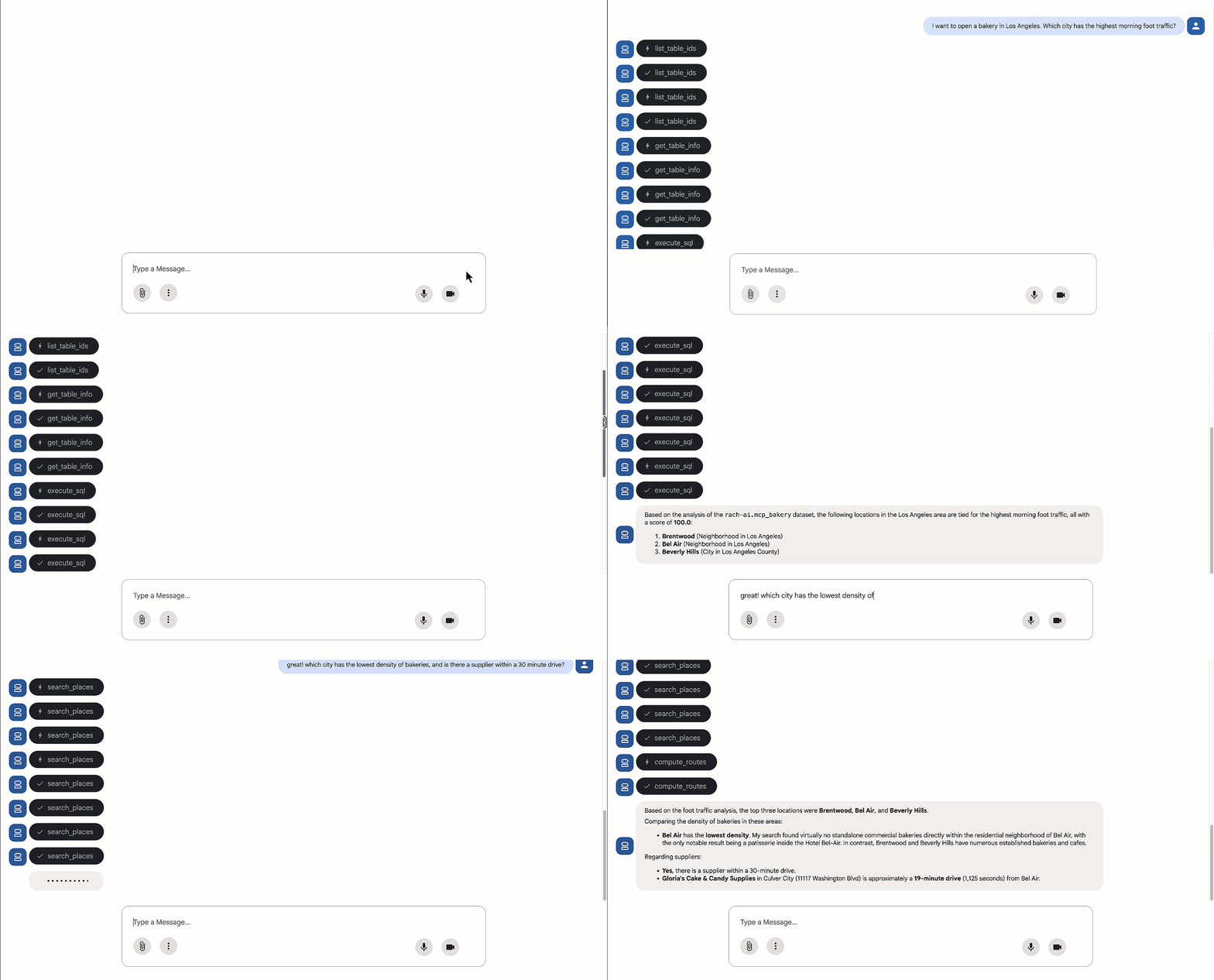
- Google Maps (Grounding Lite): Connects agents to trusted geospatial data. An assistant can answer questions like "How far is the nearest park?" or "What should I pack for the weather in Los Angeles?" without hallucinations, based on fresh information about places and routes.
- BigQuery: Allows agents to interpret schemas and execute queries on enterprise data directly where it resides, maintaining governance and avoiding security risks associated with moving data into context windows.
- Google Compute Engine (GCE): Enables autonomous infrastructure management. Agents can handle workflows, from initial provisioning to dynamic resizing based on load.
- Google Kubernetes Engine (GKE): Offers a structured interface to interact with Kubernetes APIs. Agents can diagnose issues, remediate failures, and optimize costs without parsing complex text outputs.
Security and Collaboration
Google brings order to the ecosystem with the new Cloud API Registry and Apigee API Hub, facilitating the discovery of trusted MCP tools. Security is guaranteed by rigorous controls via Google Cloud IAM and audit logging, as well as Google Cloud Model Armor protection against threats like indirect prompt injection.
"Google's support for MCP across such a diverse range of products, combined with their close collaboration on the specification, will help more developers build agentic AI applications. As adoption grows among leading platforms, it brings us closer to agentic AI that works seamlessly across the tools and services people already use."
David Soria Parra, Co-creator of MCP & Member of Technical Staff, Anthropic
Next Steps and Official Link
In the coming months, support for the Model Context Protocol will be extended to other services, including Cloud Run, Cloud SQL, Spanner, and Google Security Operations. Google, as a founding member of the Agentic AI Foundation, is committed to leading the evolution of this open-source standard.
For full technical details, you can refer to the official announcement post: Announcing official MCP support for Google services.
FAQ about Model Context Protocol and Google
What is the Model Context Protocol (MCP) and why is it important?
The Model Context Protocol is an open-source standard that acts as a universal connector between AI models and external data or tools. It is crucial because it allows AI agents to perform complex tasks by interacting with the real world and enterprise data securely.
Which Google services currently support the Model Context Protocol?
At launch, support includes Google Maps for geospatial data, BigQuery for data analytics, Google Compute Engine for infrastructure management, and Google Kubernetes Engine for container operations.
How does Google's managed approach to MCP improve security?
Google provides centralized and managed endpoints that natively integrate security controls such as Google Cloud IAM, audit logging, and Model Armor, reducing the risks associated with managing uncontrolled local MCP servers.
Can I use my enterprise APIs with Google's MCP support?
Yes, thanks to Apigee integration, companies can expose their internal APIs and business logic as discoverable and governed tools for AI agents using the protocol.