Introduction
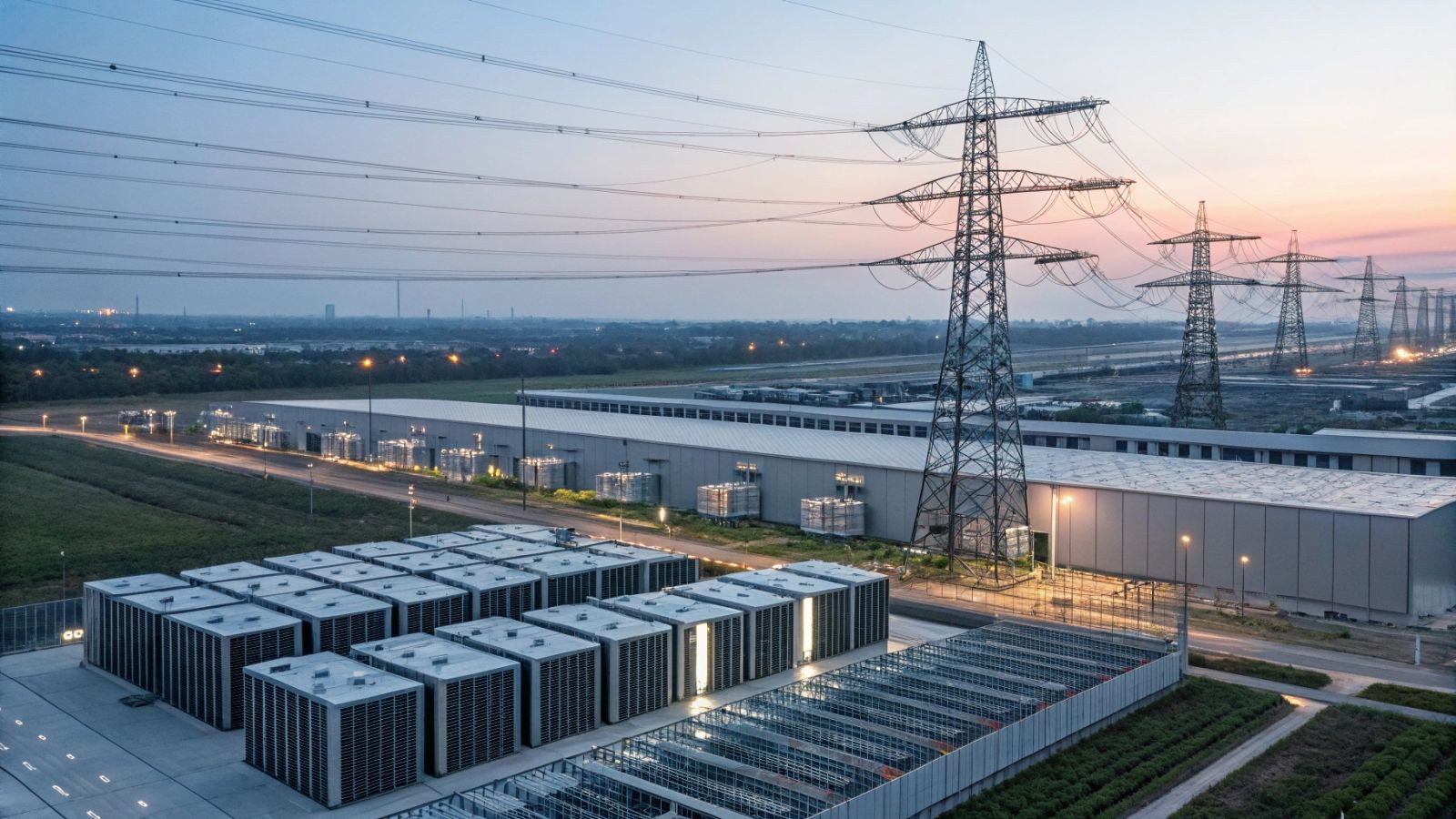
The shuttered Homer City coal plant in Pennsylvania hasn't disappeared—it has evolved. Once a symbol of industrial decline, the site is being reborn as a massive 4.5-gigawatt gas-fired data center campus. This project is the brutal emblem of the 2025 energy reality: Artificial Intelligence has a thirst that renewables alone cannot quench.
Current projections confirm that by 2030, data centers will devour over 10% of the entire U.S. power grid, a stark jump from just 4% a few years ago. We aren't just talking about code; this represents energy consumption equivalent to 16 Chicagos combined.
Analysis and Details
The Mega-Projects: Unprecedented Scale
The AI arms race has triggered "terawatt-scale" infrastructure investments. Late 2025 data highlights three critical fronts:
- Pennsylvania (The Homer City Pivot): The project creates a new reality on old coal grounds. Seven new gas stations will power a load equivalent to the entire Philadelphia urban area. The transition isn't to green energy, but to immediate, baseload power availability.
- Wyoming (Project Cosmos): In Cheyenne, the partnership between Crusoe Energy and Tallgrass is developing a campus starting at 1.8 GW and scaling to a staggering 10 gigawatts. For context: that is enough energy to power every home in Wyoming 20 times over.
- Louisiana (Meta's Gamble): Mark Zuckerberg has secured a $30 billion financing deal (with Blue Owl Capital) for the "Hyperion" site. Located in Richland Parish, this represents one of the largest private capital deals in the sector's history, destined to become the backbone for training next-generation Llama models.
The Grid Wall
The grid isn't ready. PJM Interconnection, the operator managing the grid for 65 million people in the Eastern U.S. (including Virginia's "Data Center Alley"), has sounded the alarm. PJM's independent monitor explicitly asked FERC to indefinitely block new interconnections for data centers lacking dedicated power supplies, warning that system reliability is compromised.
Consumers are already paying the price: capacity costs in the PJM area have spiked by approximately $16 billion in recent auctions, a cost that will trickle down to residential bills.
Impact on Market / Competitors
The Failure of Climate Targets
The "Green AI" narrative has collided with physics. 2025 environmental reports show a harsh reality for Hyperscalers:
- Google: Admitted its "Net Zero 2030" goal is now "very difficult." Emissions have surged nearly 50% since 2019, driven by the energy intensity of TPU and GPU chips.
- Microsoft: Despite the deal with Constellation Energy to restart Three Mile Island Unit 1 (the so-called "nuclear fix"), total emissions are up roughly 30% from the 2020 baseline.
The strategy has shifted: no longer "reduce first, offset later," but "build everything needed, gas included, and hope Carbon Capture (CCS) or fusion arrives in time." Currently, natural gas is the only source capable of guaranteeing the 24/7 continuity required by AI training clusters, filling the gaps left by intermittent solar and wind.
Conclusion
We face an infrastructure fork in the road. AI has become a physical resource consumer comparable to 20th-century heavy industry. As Big Tech bets billions on gas and nuclear to avoid losing technological supremacy to China, the cost falls on grid stability and global climate goals. PJM's call to block connections isn't bureaucratic red tape; it is the canary in the coal mine signaling the exhaustion of America's physical grid capacity.
FAQ
How much power do data centers use compared to homes?
Currently, a single "hyperscale" data center campus can consume as much power as 3 million homes. By 2030, total U.S. data center consumption is projected to exceed 430 trillion watt-hours annually.
Why reopen coal or gas plants for AI?
AI requires constant (24/7) power that intermittent renewables (sun/wind) cannot guarantee without massive battery storage, which is currently too expensive. Natural gas offers this immediate stability.
What is the impact on consumer electric bills?
In the PJM region (Eastern U.S.), capacity costs have already risen by $16 billion. This infrastructure overload translates directly into higher residential electricity bills.
Will Google and Microsoft meet their climate goals?
It is unlikely. Both companies have reported significant emission increases (30-50%) due to AI expansion, admitting that their 2030 targets are now at critical risk.