Introduction: The New Global AI Order
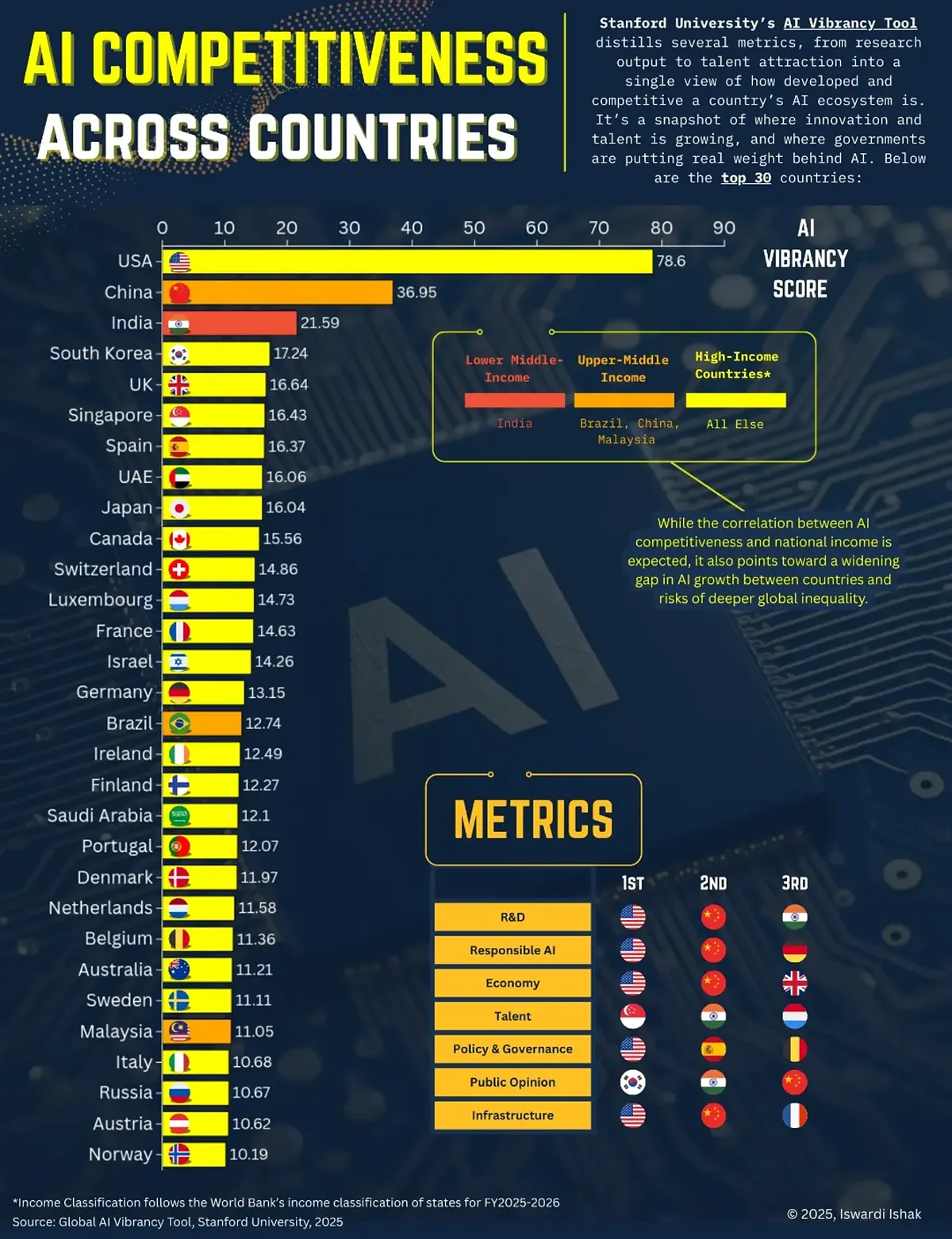
Data just released from Stanford University's 2025 Global AI Vibrancy Tool outlines a rapidly shifting geopolitical landscape. While the United States' lead (score 78.6) comes as no surprise, the seismic news is India's rise (21.59) to 3rd place, overtaking established powers like the UK, South Korea, and Germany. As Washington and Beijing continue their league-of-their-own race, a "third way" is emerging, driven by mass talent and digital sovereignty strategies.
Analysis and Details: Beyond the Numbers
The Stanford index doesn't just measure computing power; it aggregates 42 indicators across key pillars such as R&D, economy, infrastructure, and public opinion. Here is what the 2025 data actually tells us:
1. American Hegemony and the Chinese "Gap"
With a score of 78.6, the US isn't just winning; it's playing a different game. The engine of this dominance is the private sector: companies like OpenAI, Google, and Anthropic released frontier models in 2024-2025 (such as the cited Gemini 2.0 Pro and Llama 3.1) that have outpaced the competition. China (36.95) holds second place thanks to massive patent output and scientific publications but faces headwinds from restrictions on access to advanced chips (GPUs), limiting the training of the largest models.
Source: Global AI Vibrancy Tool, Stanford University, 2025
2. India's Surge (The Talent Factor)
India's leap to 3rd place is the year's most significant data point. Unlike the US and China, which rely on capital and hard infrastructure, India wins on human capital and Digital Public Infrastructure (DPI). The report highlights India becoming the global hub for AI development, with one of the largest concentrations of developers on GitHub and a government "AI for All" strategy integrating intelligence into public services at scale.
3. The "Small Giants": Singapore, UAE, and Spain
You don't need to be a demographic superpower to excel. Countries like Singapore (6th) and the UAE (8th) prove that efficiency beats size. Their "Sovereign AI" strategies (like the Falcon model for UAE) and pervasive workforce adoption (reaching 60% according to related Microsoft/LinkedIn reports) make them living labs for applied AI. Spain (7th) is also a standout, outperforming Germany thanks to a proactive approach in Governance and public sector adoption, having early established AESIA (Spanish Agency for the Supervision of AI).
Market Impact and Conclusion
The gap between high-income nations and the rest of the world is widening, creating tangible risks of global inequality. However, the Indian exception (a lower-middle-income country in the top 3) suggests that investing in education and open-source can offer a competitive shortcut. For European companies, the message is clear: regulation alone is insufficient to maintain competitiveness without massive investments in R&S and computing infrastructure.
FAQ
What is the main driver of the US lead?
The US dominance (78.6) is primarily driven by record private investment and leadership in developing advanced foundation models (GenAI) by tech giants and Silicon Valley startups.
Why has India overtaken European nations like the UK and Germany?
India leverages its massive STEM talent pool (AI engineers and developers) and rapid adoption of digital public infrastructures, compensating for lower financial resources compared to the West.
What does "AI Vibrancy" mean?
It's not just technology. "Vibrancy" measures the overall health of the AI ecosystem, including research quality, economic strength, ethics (Responsible AI), political governance, and public opinion/trust.
Why is China lagging behind the US despite its patents?
Although China produces vast amounts of research and patents, the "Vibrancy Tool" penalizes the gap in access to top-tier hardware (due to chip sanctions) and a less diverse private startup ecosystem compared to the US.
How do small countries like Singapore and UAE rank in the top 10?
They focus on "Sovereign AI" strategies, targeted state investments in GPUs, and agile regulatory frameworks (sandboxes) that foster extremely rapid adoption of technologies by businesses and government.